

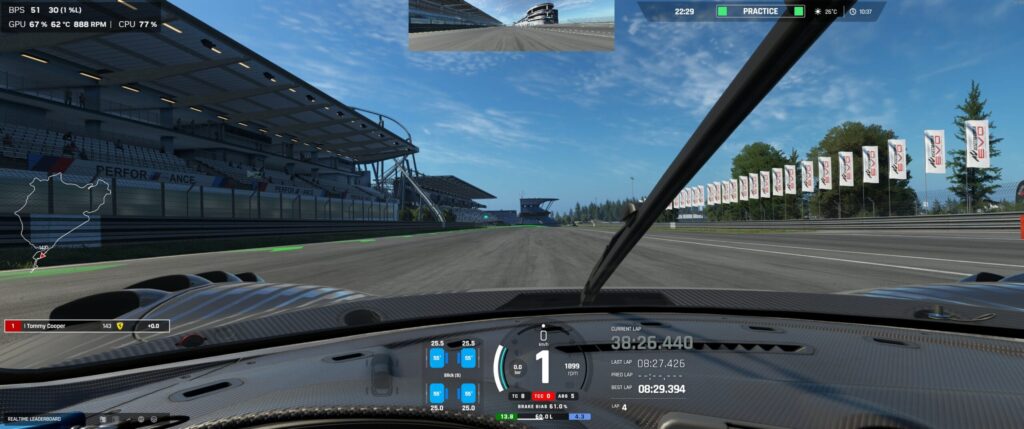
For years I’ve always believed that the most realistic way to drive in a simulator was using the Cockpit View. After all, that’s how you drive a real race car, right?
Well… not exactly.
After spending hundreds of laps around the Nürburgring in Assetto Corsa EVO, I started questioning whether the default cockpit camera is actually realistic—especially for those of us using a single ultrawide monitor.
Recently, I decided to create my own camera position.
The result?
New Personal Best: 8:29.394 around the Nürburgring 24h in the Ferrari 296 GT3.
Was it only because of the camera? Of course not. I also refined my setup and Force Feedback. But the new view made me feel far more connected to the car than ever before.
The “Back seat” feeling
I recently watched a YouTube discussion about cockpit views and came across a comment that made me smile: “I just miss the pictures of guys sitting in the back seat of the car, with a steering wheel in front of their steering wheel.”
Funny?
Absolutely.
Accurate?
Surprisingly… yes.
Many default cockpit cameras feel as if you’re sitting behind the actual driver. You see:
- A huge dashboard
- An enormous steering wheel
- A massive amount of roof
- Very little windshield
Instead of looking through the windshield, it often feels like you’re looking at the interior. That isn’t how I experience driving a real car.

How we actually see when driving
Go outside and sit in your own car.
Look straight ahead.
You’ll notice something interesting.
You barely pay attention to the dashboard.
You don’t focus on the steering wheel.
Your eyes naturally look through the windshield, far down the road.
Your brain filters out most of the interior.
That’s exactly what I wanted to recreate in Assetto Corsa EVO.
My goal
I wasn’t trying to create a camera that looks realistic.
I wanted one that feels realistic.
To achieve that I:
- moved the camera forward
- lowered the seating position slightly
- shifted it as far left as the game allows
- removed the virtual steering wheel
- kept enough dashboard visible to preserve immersion
The result feels much closer to what I experience when driving a real car.

One screen isn’t reality
This is an important point.
Many people calculate the mathematically perfect Field of View.
Those calculations are correct.
But they are based on geometry—not necessarily on human perception.
With a single 34-inch ultrawide monitor, you don’t have:
- peripheral vision
- depth perception
- head movement
- stereo vision
Trying to replicate reality perfectly is impossible.
Instead, I prefer to recreate the feeling of sitting behind the wheel.
For me, that’s more important than matching theoretical camera geometry.
Why it works for me
After switching to this camera position, I immediately felt more comfortable.
I could:
- judge the car’s position more accurately
- place the car closer to the curbs
- look further ahead through corners
- feel more relaxed during long stints
The car simply became easier to drive consistently.
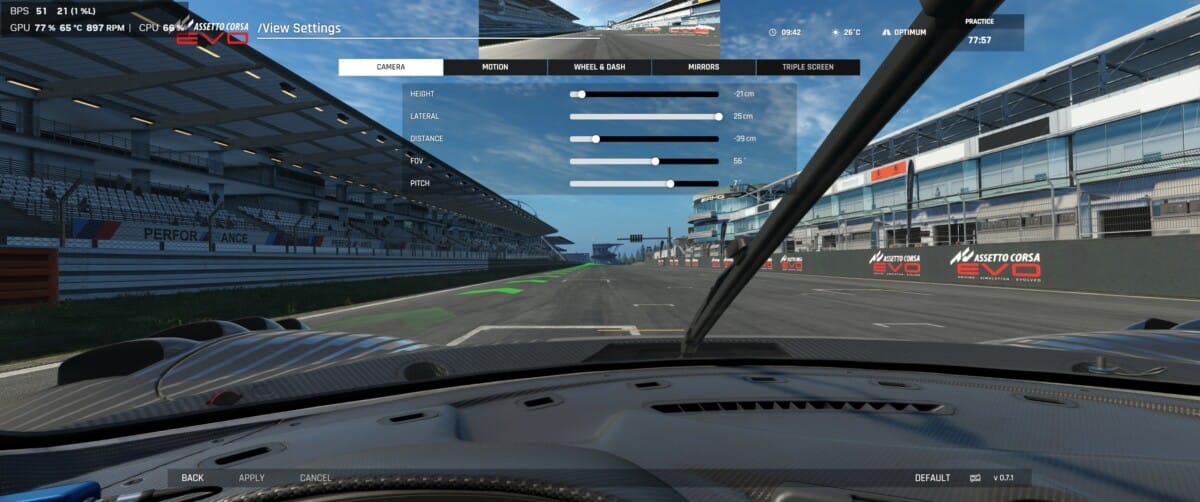
Hood view values
I have started from hood view, and the values are:
- Height = -21 cm
- Lateral = 25 cm (Unfortunately that’s max)
- Distance = -39 cm
- FOV = 56 °
- Pitch = 7 °
Does this mean the default view is wrong?
No.
If you’re driving in VR or on triple screens, the default cockpit view may be exactly what you want.
But for those of us using a single monitor, I believe there’s room for improvement.
Every driver is different.
Every sim rig is different.
Every monitor setup is different.
The best camera isn’t the one that looks most realistic in a screenshot.
It’s the one that helps you drive naturally.
Final thoughts
There is no universal “best” cockpit view.
Only the one that works best for you.
Don’t be afraid to experiment.
Move the camera.
Adjust the height.
Change the distance.
Find the position where the car feels like an extension of yourself.
For me, that journey ended with a new official Nürburgring 24h personal best:
8:29.394
And perhaps more importantly…
For the first time, I truly felt like I was sitting in the Ferrari—not watching someone else drive it.